Your First Aikido Class
At Home
Please be sure to read the etiquette page here. You will be entering a place that adheres to Japanese discipline. You may also print a PDF here for your reference.
Before Class
Please arrive 15 minutes early so you can meet the instructor, and sign the “Assumption of Risk” waiver form. Wear loose, comfortable clothing that you can move in easily, with pants that reach below your knees (to protect your knees from mat burn). Both men and ladies change rooms are available. If there is extra time before class starts, you can do any warm-up or stretching that you like.
If you register for lessons, you are expected to purchase a Gi (training uniform) within two weeks of starting your lessons. Please see the instructor for details and pricing.
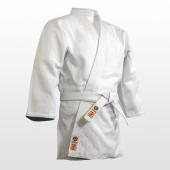
Aikido Gi
Hygiene
Please come to the dojo with a clean body and clean breath. Please also keep fingernails and toenails trimmed for the safety of your training partners. The same ideas hold for the clothes in which you train: They should be clean, free from unpleasant odors, and in good repair.
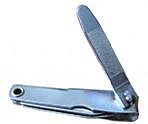
Keep nails trimmed please
It is a good idea to take a pair of flip-flops or slip-on’s with you to wear from the changing rooms to the training area.
Entering the Dojo
Please do a standing bow towards the shomen (the front of the class) whenever you enter or leave the dojo. This is a sign of respect for your fellow members and the dojo.
Please announce yourself by saying either in a loud voice (yes, loud voice):
- O-ha-yo-go-za-i-ma-su – “Good morning”
- Kon-ni-chi-wa – “Good afternoon”
- Kom-ban-wa – “Good evening”
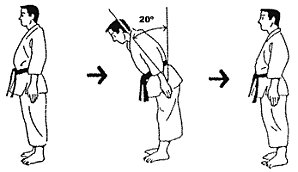
Standing bow (ritsu rei)
Bowing In
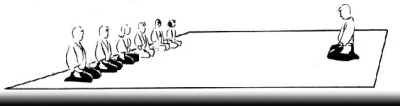
Seiza before class
When class is about to begin, students sit in seiza (kneeling) in a line facing the shomen (the display on one wall of the practice area). The instructor leads the class in bowing towards the shomen. Then the instructor and the class bow to one another, saying “o-ne-gae-shi-ma-su“, which means roughly “will you teach me please.”
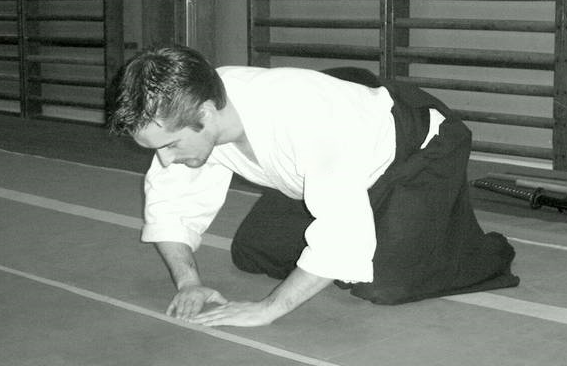
Proper Bow or Rei
Warming up
The instructor or a senior student usually leads the class in warm-up exercises called aikitaiso. These usually take about 15 minutes and are designed to do a full stretch of legs, arms, neck, fingers, and joints as well as to relax the body before class. You will be expected to eventually know and count in Japanese from 1 to 10.
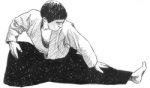
Warm-up and stretching
Falling and Rolling
In a beginning class, you will be assigned to a senior student to practice a basic back fall which involves going down to one knee and rolling backward. This helps you to learn how to take falls safely.
You will also begin to learn forwards and backwards rolls. Beginning classes do not include techniques that require forward rolls, but we practice rolling so that you will be able to take those falls later as you progress in your practice. We roll on soft mats.
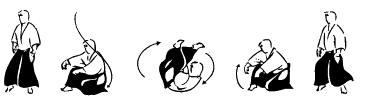
Ushiro Ukemi (backroll)
During Class
The choice and order of activities in the class are up to the instructor, except that “bowing in” always signals the start of the class, and “bowing out” signals the end.
Techniques
Most of the class is devoted to practicing a few particular Aikido techniques. Usually, in beginning classes, the “attack” is a static grab or hold, which is simpler to deal with than a strike.
Techniques are practiced much more slowly than real-time, so that you can learn each of the movements. Emphasis is placed on staying relaxed throughout the movement, and being aware of your own and your partner’s energy. As you become more familiar with the movements, the pace will increase, and you will progress to working with a partner approaching to grab or strike.
Typically, the instructor demonstrates a technique or a movement, and then the class splits into pairs or small groups to practice what was demonstrated. Partners take turns in the roles of attacker (”uke”) and defender (”nage”). Both roles are equally important, and the goal is to maintain awareness and relaxation at all times.
After the instructor has finished demonstrating, repeat the name of the technique loudly, then say “o-ne-gae-shi-ma-su” (”Please”) to the instructor.
… a few minutes go by …
When the instructor claps, this signals the end of that partner practice. Both you and your partner should thank each other by sitting in seiza (kneeling) and then bowing to each other. Say “a-ri-ga-tou go-za-i-ma-shi-ta” which means “thank you”. Sit to the side in seiza or cross-legged for the next demonstration.
Ki Breathing or Mokusou
The instructor may take a few minutes at the beginning or end of class for “ki breathing”, which is a controlled breathing practice that helps develop one point and coordination of mind and body. He will say “mokusou” to signal this. Sitting in a relaxed, centered posture (usually seiza), you take long, slow breaths, in through the nose and out through the mouth (with a slightly audible “ha” sound). This is a calming session lasting just a few minutes or less.
Bowing out
Seiza before class
At the end of class, the instructor leads the students in bowing towards the shomen (the front of the class). Then, the instructor and the class bow to one another. It is traditional to say “dou-mo a-ri-ga-tou go-za-i-ma-shi-ta” or “Thank you very much” when bowing to the instructor at the end of class to show your appreciation.
Finally, each member of the class bows to and thanks every other member for their contribution to the class.
All members help to put away the mats. Follow senior students because the mats are put away in a particular way to keep them clean.
Leaving the Dojo
Sign the attendance sheet even if it is your first class.
When you leave, do a standing bow and say one of the following:
- O-tsu-ka-re-sa-ma – roughly “Good work, Everyone”
Japanese: お疲れ様 - Sa-ki-ni-shi-tsu-rei-shi-ma-su – roughly “I’m leaving now” (very polite in Japanese)
Japanese: 先に失礼します - O-ya-su-mi-na-sa-i – “Good night” (polite)
Standing bow (ritsu rei)
REVIEW
When entering the dojo, say either:
O-ha-yo-go-za-i-ma-su – “Good morning”
Kon-ni-chi-wa – “Good afternoon”
Kom-ban-wa – “Good evening”
When starting practice after the instructor demonstrates, say:
o-ne-gae-shi-ma-su – “Please”
After finishing a practice with a partner, say:
a-ri-ga-tou go-za-i-ma-shi-ta – “Thank you”
When leaving the dojo, say either:
o-tsu-ka-re-sa-ma – “Good work, Everyone”
sa-ki-ni-shi-tsu-rei-shi-ma-su – “I’m leaving now”
O-ya-su-mi-na-sa-i – “Good night” (polite)